2025 marks 35 years of Interreg. Throughout these decades, Interreg has fostered collaboration across borders, bringing European regions together to solve common challenges and create shared solutions. But where does Interreg North-West Europe fit in this history? Let's explore the journey of the Interreg North-West Europe Programme and how it evolved into the transnational cooperation programme we know today.
The seeds of cooperation: before Interreg
Long before Interreg became an official EU instrument, the seeds of transnational cooperation were already being planted in North-West Europe.
In 1868, the foundations were laid when Baden, Bavaria, France, Hesse, the Netherlands and Prussia signed the Mannheim Act, establishing freedom of navigation on the Rhine. The Central Commission for Navigation on the Rhine, which drafted and implemented this act, is still regarded today as a model for international organisations in the field of economic, administrative and political cooperation – proving that cooperation has deep roots in the NWE area.
The establishment of the Conference of North-West European Regions (CROWNE) in 1955 marked another milestone for cooperation in the area. This international association, which aimed to develop a common spatial planning strategy, would become one of the oldest cross-border organisations in Europe.
The birth of Interreg
1990
The European Commission launches Interreg as the EU’s official framework for territorial cooperation, with the aim to facilitate joint actions and policy exchanges between national, regional and local actors from different Member States.
The overarching objective of European Territorial Cooperation (ETC) was to promote a balanced territorial development of the Union. Starting with a budget of EUR 1 billion, Interreg initially focused on cross-border cooperation (=Interreg A) before expanding to include transnational (=Interreg B) and interregional cooperation (=Interreg C).
1997
As Interreg gained momentum, CROWNE stopped operating when two Interreg transnational programmes started in the NWE area: Interreg Rhine Meuse Activities (IRMA) and the North-West Metropolitan Area (NWMA).
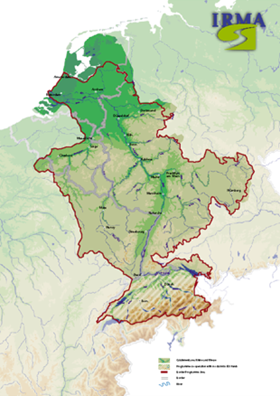
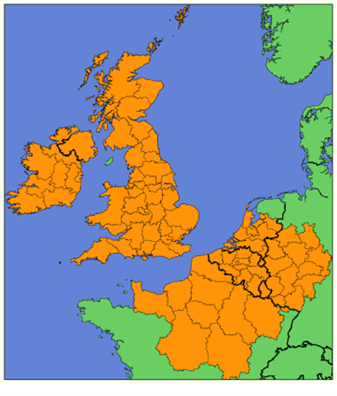
Figures: on the left the Interreg Rhine Meuse Activities area / on the right the North-Western Metropolitan Area (NWMA)
These programmes had distinct focuses that reflected the pressing challenges of the time. IRMA was developed in response to severe flooding events in the 1990s, concentrating on addressing water management challenges in the Rhine and Meuse catchment areas. Meanwhile, NWMA took a broader approach, focusing on urban and regional development, infrastructure, natural resources, and cultural heritage.
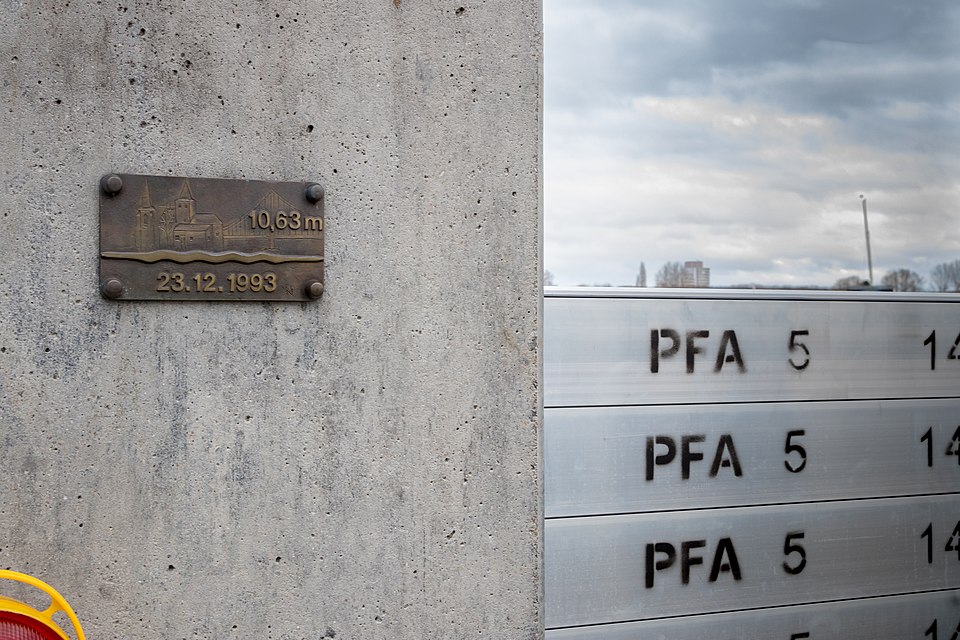
Image: Rhine flooding in Cologne in January 2018: Flood protection wall in Cologne-Rodenkirchen with flood markings on a house wall from 23 December 1993. © Superbass / CC BY-SA 4.0 (via Wikimedia Commons)
The North-West Europe Programme
2000
A significant milestone came in 2000 when an NWMA project delivered a Spatial Vision for North-West Europe, which would become the foundation for the Interreg North-West Europe Programme as we know it today.
During the 2000-2006 period, the NWE Programme invested €316 million in ERDF funding across 99 projects. These projects covered five priority areas – Cities & Regions, Transport & IT, Water & flood risks, Nature & Heritage, and Seas & Ports – bringing together 900 partners.
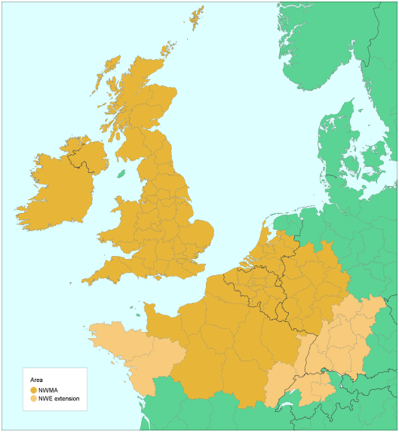
Figure: Evolution of Programme area from NWMA to NWE Programme
2001
The NWE Managing Authority is transferred from the Essex County Council to the Région Nord-Pas-de-Calais (now Région Hauts-de-France). This meant relocating the Joint Secretariat from London to Lille.
At the time, the Secretariat team employed six people, having operated with just three for most of the NWMA period. The Joint Secretariat was supported by “National Contacts”, who were already there to support the Programme, especially project applicants and beneficiaries.
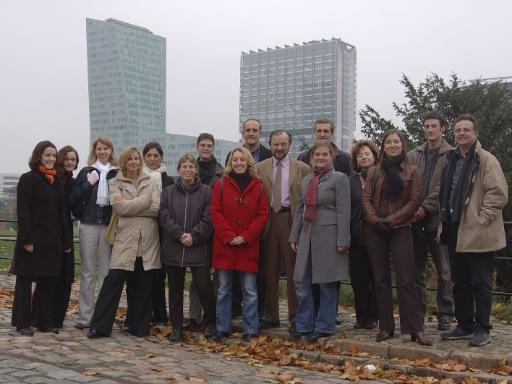
Image: The Joint Secretariat team in Lille in 2004
2007
The IVB Programme (2007-2013) was launched with an increased total budget of €355 million ERDF. This period saw 114 projects covering four priority areas – Innovation, Environmental challenges, Connectivity, Strong & prosperous communities – with approximately 800 project partners.
"One of the biggest successes on the territorial level, was the whole portfolio of water projects in IIIB and IVB. We had some groundbreaking projects such as the Dutch concept of "Room for the River" – creating more space for rivers to flood within their natural range and, as a result, reducing flood risk. It set the scene for river management.”
Ruut Louwers • NWE Programme Director from 2007 to 2020
2012
The programme approved its first capitalisation strategy towards the end of the 2007-2013 Programme implementation phase. By adopting a structured approach to capitalisation, the Programme signalled its commitment to creating lasting impact beyond individual project lifespans.
2014
The 2014-2020 Programme was approved in June 2015 with a budget of €396 million ERDF. During this period, 102 projects were approved covering three priority areas – Innovation, Low carbon, Resources & materials efficiency.
One of the main features of this new programme was the strong result orientation with indicators focusing on, for instance, jobs created, CO2 emission reductions or waste avoided. This contributed to opening the door wider to private companies and SMEs in our programme, which made up about 50% of all funded partners.
2018
Recognising the urgent need to accelerate the energy transition in North-West Europe to reach EU 2030 objectives, the Programme organised a thematic targeted call on renewable energy. Through this initiative, over €40 million ERDF were allocated to projects aimed at increasing both the supply and demand of renewable energy across the region.
2019
The Programme broke new ground by organising its first call for capitalisation, enabling the further uptake of project results and maximising their impact. This mechanism provided additional resources for projects to extend their results to new geographical areas, new target groups or new economic sectors. During the 2014-2020, two calls for capitalisation were organised, supporting 33 projects with a total budget of €30 million.
2020
Following the referendum in 2016, the United Kingdom left the EU in 2020, bringing significant changes to the programme's geography and partnerships.
"Certainly, Brexit has been a huge challenge for the NWE Programme. UK partners have contributed significantly with their activities to transnational NWE project results over the last decades.
At the same time, it is a huge success for the NWE Programme, that even after Brexit the programme can still provide attractive and useful opportunities for transnational cooperation in North-West Europe, especially involving also more rural and peripheral territories.”
Sabine Stölb • Member State representative for Luxembourg from 1998 to 2024
The present and future
2021
The 2021-2027 Programme is launched with a total budget of €310 million. The Programme geography is changed with not only UK's departure, but also the integration of new regions located in northern Netherlands and Germany. A wide range of topics are covered, some reconnecting to earlier programming periods – sustainable tourism, biodiversity, and nature preservation for instance.
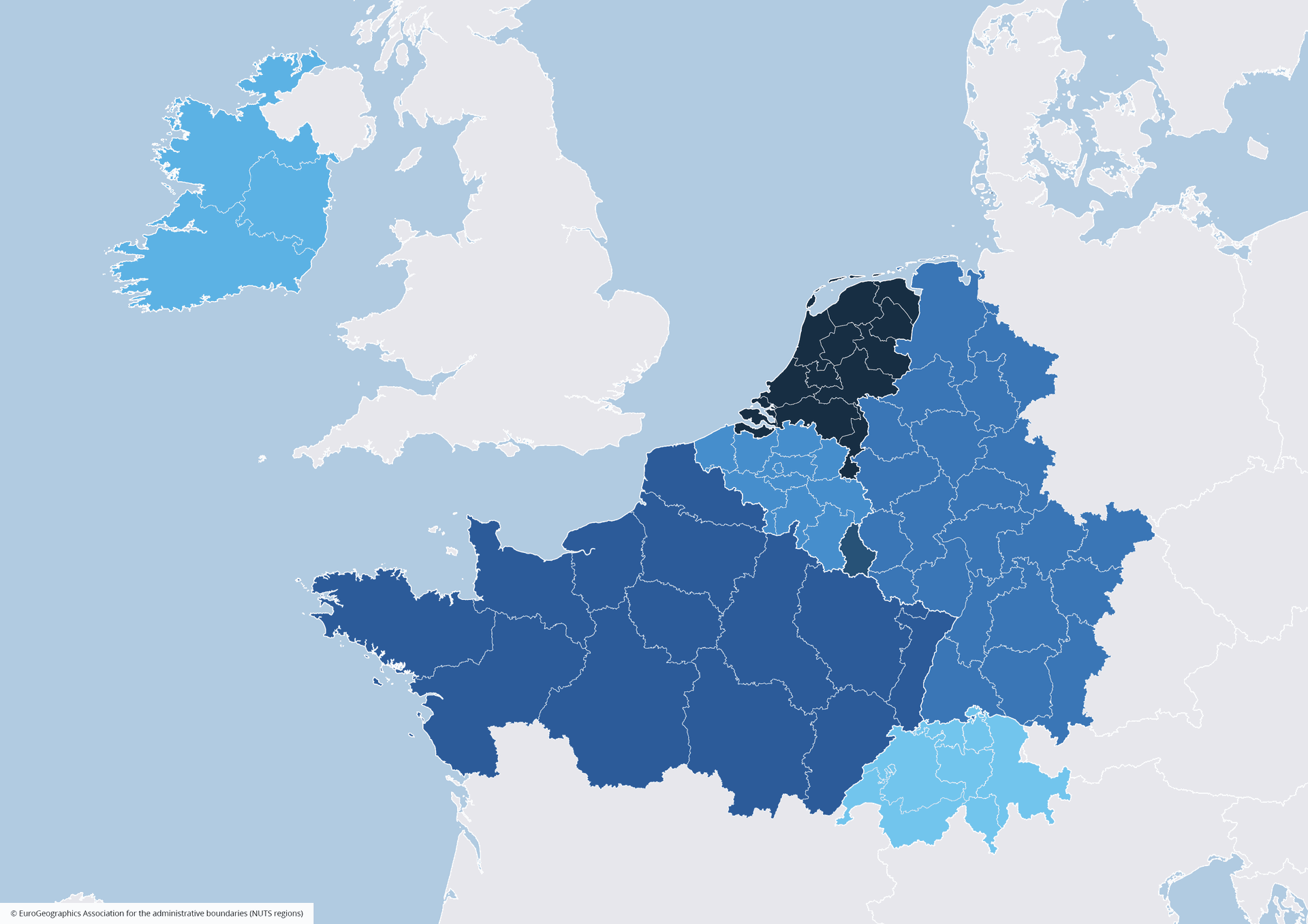
Figure: NWE area in the 2021-2027 Programme
Five call for projects have been organised up to now, among which a small-scale project call aiming to make the Programme more accessible to newcomers. This initiative, combined with the simplification measures introduced in this programming period opened doors to different types of organisations, often those less experienced in Interreg.
2025
As we celebrate the 35 years of Interreg, we now stand at the midpoint of the 2021-2027 period. To date, 91 projects have been approved across calls 1-5, including 15 small-scale projects that have already ended.
The focus of the NWE Programme is now shifting from calls to implementation and impact with a capitalisation strategy aiming to support projects in enhancing the uptake of their outputs. Drawing on the successful experience of the 2014-2020 period, the 2021-2027 Programme will launch its first call for capitalisation in December 2025.
In parallel, the Interreg NWE Programme is already looking towards the future, actively participating in discussions on shaping the next chapter of European territorial cooperation, and what it could look like for North-West Europe in 2028-2035.
"In the future, I hope that European cooperation still makes a big difference and enables our territory to work on common solutions to challenges related to natural risks, mobility, digital technology, etc. We can expect a strengthening of the multi-level governance dynamics already visible today. All governance levels – local, national and European – would be mobilised to ensure tailor-made decision-making for each territory. I hope that there will be less regional disparities due to European cohesion policy in a visible, active and solid Europe close to citizens.”
Anne Wetzel • Région Hauts-de-France Managing Authority of the NWE Programme
References
Kümper, H., & Maurer, A. (2018). 150 jahre Mannheimer akte: Festschrift zum 150jährigen Bestehen der Revidierten Rheinschifffahrtsakte vom 17. Oktober 1868.
Medeiros, E. (2018). European Territorial Cooperation: Theoretical and Empirical Approaches to the Process and Impacts of Cross-Border and Transnational Cooperation in Europe. Springer.